* * * * *
Bodegas Aliaga, Corella (Navarra)
The wines of Carlos Aliaga and his family.
The wines of Carlos Aliaga and his family.
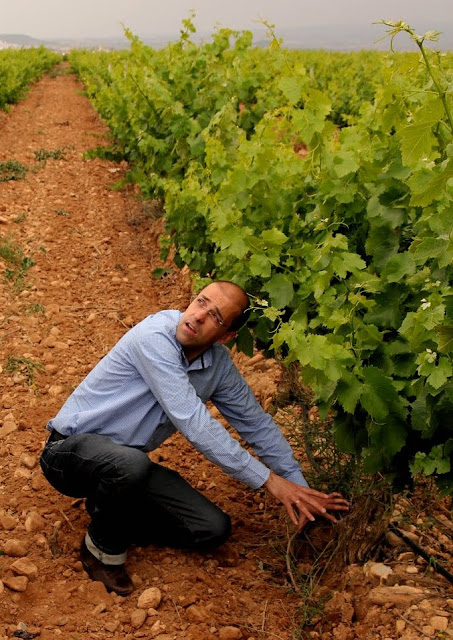
Carlos Aliaga showing his Viña Aliaga vineyards to a visitor.
Photo by Gerry Dawes©2011 / gerrydawes
The Wines of Aliaga and Restaurante El Crucero
(Click on the El Crucero titles below to see photos of the restaurant and its dishes.)
Aliaga Lágrima de Garnacha Rosado 13.5%

Made from free-run juice from 100% old vines Garnacha from the Viña Aliaga vineyard located at Ombatillo near Corella in the heart of the Ribera Baja of Navarra. The soil is calcareous and poor; vine density is 1,200 vines per acre.
This superb, lovely rosado is made by the free-run sangrado de lágrima method. After brief contact with the red grape skins, the grape juice is separated by gravity without using any mechanical pressing, after which the must is fermented in temperature- controlled stainless steel tanks for 20 days at 14º C. (57º F.)
Fresh, clear and brilliant strawberry-cherry colour. The fragrant bouquet is reminiscent of fresh fruit. On the palate the wines is clean, smooth and will balanced with a hints of flowers and cherries and a long, persistent mineral-laced finish. This wine steadily evolves with time in bottle and is often superb 2-3 years from the vintage.
Food Pairings: Ideal for tapas, first courses, aperitifs, fish and seafood, chicken, port, Asian food, pasta, pizza and salads. Not just a summer wine. If you drink cold white wine in the cooler months, you will love this great rosado all year long.
"An almost dusty-dry Navarra sangrado ("bleeding," i.e. free-run juice) rosé — meaning that it's made from free-run juice — with a light, luminous pink color and an intense strawberry fruit both on the nose and on the palate." - - Colman Andrews, The Daily Meal. Read more: Spanish Wines — A Seductive New Crop: Godello, mencia, and other less-than-famous Iberian grapes shine in a new selection from Spanish wine expert Gerry Dawes

In Tudela (Navarra) at the home of Carlos Aliaga and his wife Mari Curz with a tomatada (tomatoes, ham and snail stew from southern Navarra) made by Nabor Jimenez of Restaurante El Crucero, which was closed for vacation, and a bottle of Aliaga Rosado de Lágrima de Garnacha (Garnacha Rosado made with free-run juice), October 8, 2014. A wine represented by The Spanish Artisan Wine & Spirits Group - Gerry Dawes Selections. Photo by Gerry Dawes©2014 / gerrydawes@aol.com / Facebook / Twitter / YouTube / Pinterest. Canon G15 / Canon f/1.8 – f/2.8 5X 24-140mm IS USM.
Aliaga Tempranillo 13.5%

Brick-edged ruby. Black and red fruits, complemented by toasty oak in the nose. Round, smooth and ripe with red and black berry compote, spices, garrigues-like herbal components and persistent finish. Good with red meat, game, roasts, grilled and fried fish, Spanish, Italian and Mediterranean dishes, cheese.
Made from 75% Tempranillo and 25% Cabernet Sauvignon grown in the calcareous soil of Viña Aliaga. The wine is fermented for 6 days in stainless steel tanks at 27 º C. (80 º F.), followed by maceration on the grape skins with two stirrings every day. Aged 14 months in new American and French Allier oak. Just under 2000 cases made.
Aliaga Moscatel Vendimia Tardia Dulce 2010 12.0% 500ML

100% late harvested Moscatel de Alejandria, from the calcareous soil of a single vineyard, Viña Lorena at Fugenique near Corella in Navarra’s La Ribera Baja. Fermented for 35 days in stainless steel tanks at 12 º C. (53.6 º F.), after which by using only cooling techniques the fermentation is stopped without the addition of alcohol. Only 750 cases are produced.
Clean, clear, bright, gold-tinged color. Lovely honesuckle nose with hints of pear and peach. Very fruity with luscious honeysuckle and peach flavors and a lingering, fresh, but not unctuous finish.
Excellent with foie gras, ripe, soft cheeses and fruit-based desserts.
This superb, lovely rosado is made by the free-run sangrado de lágrima method. After brief contact with the red grape skins, the grape juice is separated by gravity without using any mechanical pressing, after which the must is fermented in temperature- controlled stainless steel tanks for 20 days at 14º C. (57º F.)
Fresh, clear and brilliant strawberry-cherry colour. The fragrant bouquet is reminiscent of fresh fruit. On the palate the wines is clean, smooth and will balanced with a hints of flowers and cherries and a long, persistent mineral-laced finish. This wine steadily evolves with time in bottle and is often superb 2-3 years from the vintage.
Food Pairings: Ideal for tapas, first courses, aperitifs, fish and seafood, chicken, port, Asian food, pasta, pizza and salads. Not just a summer wine. If you drink cold white wine in the cooler months, you will love this great rosado all year long.
"An almost dusty-dry Navarra sangrado ("bleeding," i.e. free-run juice) rosé — meaning that it's made from free-run juice — with a light, luminous pink color and an intense strawberry fruit both on the nose and on the palate." - - Colman Andrews, The Daily Meal. Read more: Spanish Wines — A Seductive New Crop: Godello, mencia, and other less-than-famous Iberian grapes shine in a new selection from Spanish wine expert Gerry Dawes
In Tudela (Navarra) at the home of Carlos Aliaga and his wife Mari Curz with a tomatada (tomatoes, ham and snail stew from southern Navarra) made by Nabor Jimenez of Restaurante El Crucero, which was closed for vacation, and a bottle of Aliaga Rosado de Lágrima de Garnacha (Garnacha Rosado made with free-run juice), October 8, 2014. A wine represented by The Spanish Artisan Wine & Spirits Group - Gerry Dawes Selections. Photo by Gerry Dawes©2014 / gerrydawes@aol.com / Facebook / Twitter / YouTube / Pinterest. Canon G15 / Canon f/1.8 – f/2.8 5X 24-140mm IS USM.
Aliaga Tempranillo 13.5%
Dark cherry colour, with violet tones. The bouquet is clean, harmonic and intense. The taste is pleasant and reminiscent of ripe red fruits, the tannins are well-integrated and overall effect fresh, persistent and lasting. This wine is ideal for red meat, game, roasts and well-cured cheeses.
Straight forward, good, un-blended, un-oaked Tempranillo, a relative rarity in Navarra, where there is a multitude of tempranillo wines, often blended with mediocre cabernet sauvignon. Made from 100 % Tempranillo grapes grown in the calcareous soil of Viña Aliaga. The wine is fermented for 6 days in stainless steel tanks at 28 º C. (82 º F.).
Aliaga Garnacha Vieja Tinto 2010 13.9%

100% old vines Garnacha grown in the calcareous 1,200 vine per acre Viña Aliaga vineyard.
The wine is fermented for 6 days in stainless steel tanks at 28 º C. (82 º F.) followed by maceration on the grape skins for 20 days with two stirrings every day. Aged 6 months in American and French Allier oak cask, but the wines does not have heavy oak flavors. Only 2,800 cases are produced.
Deep dark cherry color. Ripe black cherry and spice nose. Round, rich black cherry fruit with hints of garrigue herbs with long, persistent finish.
Food Pairing: Ideal with red meat, game, roasts, cheeses.
Aliaga Colección Privada Tinto 2007 13.5%
Made from 80% Tempranillo and 20% Cabernet Sauvignon grown in the calcareous soil of Viña Aliaga. The wine is fermented for 6 days in stainless steel tanks at 27 º C. (80 º F.), followed by maceration on the grape skins with two stirrings every day. Aged 12 months in new American and French Allier oak. Just over 1650 cases made.
Deep black cherry colour rimmed with brick-red. The nose is intense, with “toasty” aroma from its ageing in cask, reminiscent of ripe black and red fruits. Smooth, full-bodied and round, with a long finish. A very special wine.
Good with red meat, game, roasts, grilled and fried fish, Spanish, Italian and Mediterranean dishes, cheese.

Carlos Aliaga at the edge of Aliaga's property. The vineyards are on a higher plateau. Here the vineyards end and the land drops off into an area that is covered with wild thyme and rosemary, traces of which turn up in some of the wines as what the French call garrigues. Photo by Gerry Dawes©2013 / gerrydawes@aol.com / Facebook / Twitter / YouTube / Pinterest. Canon EOS 6D / Tokina Macro 100mm f/2
Aliaga Reserva de la Familia Tinto 2005 13.5%
Straight forward, good, un-blended, un-oaked Tempranillo, a relative rarity in Navarra, where there is a multitude of tempranillo wines, often blended with mediocre cabernet sauvignon. Made from 100 % Tempranillo grapes grown in the calcareous soil of Viña Aliaga. The wine is fermented for 6 days in stainless steel tanks at 28 º C. (82 º F.).
Aliaga Garnacha Vieja Tinto 2010 13.9%
100% old vines Garnacha grown in the calcareous 1,200 vine per acre Viña Aliaga vineyard.
The wine is fermented for 6 days in stainless steel tanks at 28 º C. (82 º F.) followed by maceration on the grape skins for 20 days with two stirrings every day. Aged 6 months in American and French Allier oak cask, but the wines does not have heavy oak flavors. Only 2,800 cases are produced.
Deep dark cherry color. Ripe black cherry and spice nose. Round, rich black cherry fruit with hints of garrigue herbs with long, persistent finish.
Food Pairing: Ideal with red meat, game, roasts, cheeses.
Aliaga Colección Privada Tinto 2007 13.5%
Made from 80% Tempranillo and 20% Cabernet Sauvignon grown in the calcareous soil of Viña Aliaga. The wine is fermented for 6 days in stainless steel tanks at 27 º C. (80 º F.), followed by maceration on the grape skins with two stirrings every day. Aged 12 months in new American and French Allier oak. Just over 1650 cases made.
Deep black cherry colour rimmed with brick-red. The nose is intense, with “toasty” aroma from its ageing in cask, reminiscent of ripe black and red fruits. Smooth, full-bodied and round, with a long finish. A very special wine.
Good with red meat, game, roasts, grilled and fried fish, Spanish, Italian and Mediterranean dishes, cheese.
Carlos Aliaga at the edge of Aliaga's property. The vineyards are on a higher plateau. Here the vineyards end and the land drops off into an area that is covered with wild thyme and rosemary, traces of which turn up in some of the wines as what the French call garrigues. Photo by Gerry Dawes©2013 / gerrydawes@aol.com / Facebook / Twitter / YouTube / Pinterest. Canon EOS 6D / Tokina Macro 100mm f/2
Aliaga Reserva de la Familia Tinto 2005 13.5%
Brick-edged ruby. Black and red fruits, complemented by toasty oak in the nose. Round, smooth and ripe with red and black berry compote, spices, garrigues-like herbal components and persistent finish. Good with red meat, game, roasts, grilled and fried fish, Spanish, Italian and Mediterranean dishes, cheese.
Made from 75% Tempranillo and 25% Cabernet Sauvignon grown in the calcareous soil of Viña Aliaga. The wine is fermented for 6 days in stainless steel tanks at 27 º C. (80 º F.), followed by maceration on the grape skins with two stirrings every day. Aged 14 months in new American and French Allier oak. Just under 2000 cases made.
Aliaga Moscatel Vendimia Tardia Dulce 2010 12.0% 500ML
100% late harvested Moscatel de Alejandria, from the calcareous soil of a single vineyard, Viña Lorena at Fugenique near Corella in Navarra’s La Ribera Baja. Fermented for 35 days in stainless steel tanks at 12 º C. (53.6 º F.), after which by using only cooling techniques the fermentation is stopped without the addition of alcohol. Only 750 cases are produced.
Clean, clear, bright, gold-tinged color. Lovely honesuckle nose with hints of pear and peach. Very fruity with luscious honeysuckle and peach flavors and a lingering, fresh, but not unctuous finish.
Excellent with foie gras, ripe, soft cheeses and fruit-based desserts.
* * * * *


