Thursday, October 27, 2016

Valdeorras: Spain's Great White Hope in The Valley of Gold


* * * * *

Glass of Godello at sunset at Adegas D. Berna, Valdeorras.
Photo by Gerry Dawes©2011 / gerrydawes@aol.com
(None of the photos here were a part of The New York Times article.)


Excerpt: ". . .Some people have already made up their minds about godello.  Gerry Dawes, who has been writing about Spanish wines for decades and who recently went into the importing business, has called godello “Spain’s emerging hope as an equivalent to the great white Burgundies.”


Godello grapes, Valdeorras.
Photo by Gerry Dawes©2011 / gerrydawes@aol.com.


The consulting enologist for both D. Berna and O Barreiro is José Luís Murcía, who has more than 20 years experience making Godello in Valdeorras and consults to eight other wineries, including the stellar Casal Novo, and somehow manages to capture the essence of their grapes and vineyard sites and transmits that in the bottle like few others. 


Gerry Dawes at Chef Paco Roncero's Estado Puro in Madrid with a glass of Godello. 
Photo by Harold Heckle©2009, Associated Press, Madrid.

Adegas D.Berna, Córgomo, Villamartín de Valdeorras (Ourense)
D. Berna Godello 2010 Valdeorras 13.0% 12/750ML $24.99 

"Adegas D. Berna Godello 2010 ($25). If I were a producer of white burgundy, a wine like this, from Valdeorras in Galicia, would make me nervous. It's big, authoritative, lush, and full of fruit (peaches come to mind), but beautifully structured, with plenty of acidity and a trace of flint — just delicious."  - - Colman Andrews, The Daily Meal.  Read more: Spanish Wines — A Seductive New Crop: Godello, mencia, and other less-than-famous Iberian grapes shine in a new selection from Spanish wine expert Gerry Dawes
 
“The 2010 godello, a white from the small-production Bodegas D. Berna, in Valdeorras, was splendid.  Pointillistic, lithe, long, delivering visceral and cerebral pleasures, it was reminiscent of white peaches.  The property, Dawes wrote, is advised by “a great local, enologist, José Luís Murcía, who may know more about godello than anyone in Galicia.”  Murcía, he went on, “advises nine wineries” but “does not mark the wines with a one-fits-all winemaking stamp.” - - Howard G. Goldberg, who writes for The New York Times, Decanter and other publications.


Berna Guitián and Elena Blanco, Adegas D. Berna, Valdeorras.
Photo: Gerry Dawes©2011 / gerrydawes@aol.com.

This is the first vintage of this wine by the young couple, Berna Guitián and Elena Blanco, to reach the U.S. market.  The consulting enologist is the great José Luís Murcia, who probably knows more about Godello than anyone in Valdeorras.  

Brilliant white gold.  Intriguing nose of white peach and racy minerals. A gorgeous mouthful of silky sweet white peach fruit with a long mineral finish laced with attractive hints of peach pit and almond.  No oak.  Excellent value.


Consulting enologist at Casal Novo, D. Berna, O Barreiro and a number of other wineries in Valdeorras 
is José Luís Murcía, who, somehow manages to capture the essence of their grapes and vineyard site 
and transmit that in the bottle like few others. Photo: Gerry Dawes©2011 / gerrydawes@aol.com.

Adegas D.Berna Mencía Tinto 2011 13.0% 12/750ML $19.99

A lovely easy-drinking Mencía with smooth pomegranate fruit-laced with minerals.  

Reminiscent in style of a village Burgundy, but somewhat more akin in taste to a good Loire valley Bourgueil. 

Adegas O Barreiro, Seadur (Ourense)

Electric power line builder 'Pepe' Rodríguez retired from his own company and now, with hired help from the 140-person village of Seadur, farms his vineyards in this isolated village of Seadur, which looks down on some spectacular views from its perch some 1700 feet above sea level and 700 feet above the Valdeorras wine town of A Rúa and the Sil River valley. Seadur is reachable only by a pair of serious cork-screw secondary roads.
  

Gerry Dawes with Pepe Rodríguez, owner of O Barreiro, Seadur, Valdeorras, Galicia.

Photo: Basilio Izquierdo©2012 / gerrydawes@aol.com.

Pepe Rodríguez  farms .5 Hectares  (1.25 acres) of 30 year old Godello vines and  .25 hectares  (.6 acres) of 15-year old Mencía.   Depending upon the year, Pepe produces  500-700 6bt. cases of Godello and  just 330-500 6 bt. cases of Mencía.


Pepe Rodríguez, owner of O Barreiro, Seadur, Valdeorras, Galicia, in his vineyards. 
Photo: Gerry Dawes©2012 / gerrydawes@aol.com.

O Barreiro 'A Silveira' Godello 2010 12.5% 6/750ML  $19.99

Pretty, brilliant green-gold.  Whiffs of white peach.   Fine, racy, acidity with restrained white peach, stone fruit and bitter almond flavors.  Its tartness is balanced by lovely fruit and moderate alcohol, which makes it an exceptional food wine.  In the third glass, it's raciness is somewhat reminiscent of great Savennières and the quality, flavor and finish is as good as many white Burgundies.

"O Barreiro "A Silveira" Godello 2010 ($20). Another splendid godello from Valdeorras, a little lighter than the D.Berna, but also a touch more elegant, again with an abundance of fruit but enough acidity to balance out the opulence."  - - Colman Andrews, The Daily Meal.  Read more: Spanish Wines — A Seductive New Crop: Godello, mencia, and other less-than-famous Iberian grapes shine in a new selection from Spanish wine expert Gerry Dawes

* * * * *


* * * * *


Monday, October 17, 2016

English Version of Boquería Gourmand, a Book about Barcelona's Fabulous La Boquería Market (Foreword by Gerry Dawes)


* * * * *

Boquería Gourmand
English edition, published in October 2011 by Viena Edicions (www.vienaeditorial.com)

Email me at gerrydawes@aol.com for information about obtaining a copy of the book.


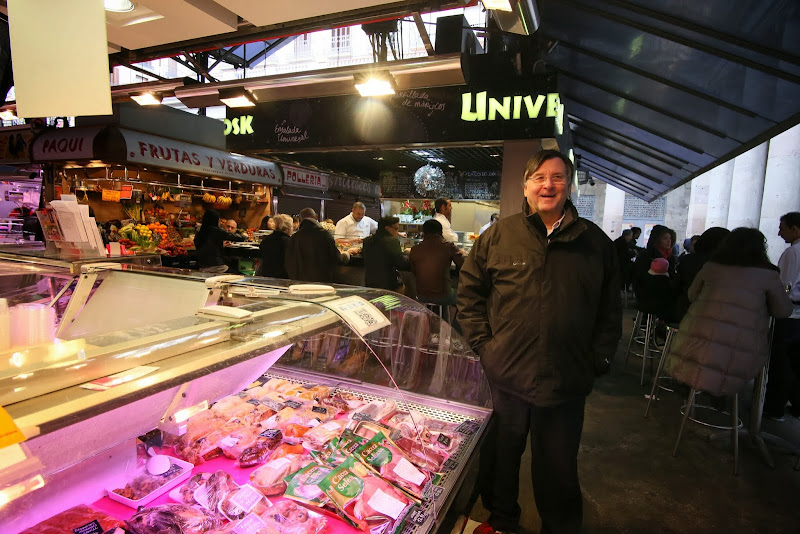
La Boquería:  My Favorite Pueblo is a Gastronomer’s Paradise
(Foreword includes additional paragraphs not in the published version.)

By Gerry Dawes©2011

Premio Nacional de Gastronomía 2003
(Stay tuned for many more photographs of La Boquería.)

El Mercat de San Josep, La Boquería. 
Photo: Gerry Dawes©2011 / gerrydawes@aol.com.
“I felt dizzy with the idea that I was part of that paradise of food. It was, and still is, a petit poble (small village) inside the big city.” - - Quím Marquéz, Chef-owner, Quím de la Boquería, Parada 606 (location), El Mercat de La Boquería. 

Quím Marquéz, Chef-owner, Quím de la Boquería
Photo: Gerry Dawes©2011 / gerrydawes@aol.com.

For forty years I have been traveling in the patrias chicas of the Iberian Peninsula.  I lived for eight years in Andalucía and have repeatedly crisscrossed El País Vasco, Galicia, Valencia, Navarra, Aragón, La Rioja, Asturias, Extremadura, the lands of Castilla y León, and all of the other provinces of Iberia, including Catalunya.  Over these decades of travel, I have come to love many "pueblos" across the vast, wonderful and exotic Iberian landscape-Sanlúcar de Barrameda (where my soul resides) and Ronda in Andalucía: Chinchón just outside Madrid; Covarrubias (Burgos); Burguete (Navarra); Haro (La Rioja), Cangas de Onís (Asturias), Gratallops (Tarragona) and Cadaqués (Girona), among many. 
 
Gerry Dawes, Juanito Bayen and Juli Soler at Pinotxo Bar, Barcelona, Jan. 14, 2014. 
 Photo courtesy of Gerry Dawes©2014 / gerrydawes@aol.com
 / Facebook / Twitter / Pinterest. Panasonic Lumix DMC ZS30 43-86mm f3.3 – f6.4.
 
As much as I long to return to such places for a variety of reasons, not the least of which is a multitude of friends and memories, few have quite the compelling attraction of Barcelona's El Mercat de San Josep, La Boquería market, which as Quím Marquéz put it so well, "still is a petit poble (small village) inside the big city" and is literally one of my favorite pueblos in the world.

Ever since I spent six weeks in Barcelona in 1970--first working as an extra on the American movie, The Great White Hope (many of the boxing scenes were filmed on Montjuic) and having anecdotal quality adventures off the set with the actor, James Earl Jones--this exciting city has occupied a favored spot in my heart.  While working on the movie, I stayed in a steeply discounted small room in the Hotel Ritz, then I moved to a very modest pensión, ironically on the calle de la Boquería.  Each day, I lived the rich Bohemian life of the legendary pedestrian artery,  Les Rambles, and the narrow, labyrinthine streets of the Barri Gotic, Raval and Born, incessantly taking photographs, including a memorable Sunday when I captured soulful images of Catalan sardana dancing in front of the Cathedral.  


Caren (from Argentina), Winged Victory. Les Rambles, Barcelona.
Photo by Gerry Dawes©2008 / gerrydawes@aol.com.

In those early days, I was not yet the gourmet and gourmand that I would become as a writer-photographer specializing in the gastronomy of Spain--in 1997, Food Arts magazine (http://www.foodarts.com/Foodarts/FA_Feature/0,4041,387,00.html) published my article on  Ferran Adrià, the first major article in the U.S. on elBulli's superstar chef.   I wandered into La Boquería on occasion (and returned there periodically on subsequent trips), but then usually I went on to explore Barcelona's other attractions- Les Rambles, the Barri Gotic, Montjuic, La Barceloneta and Antoni Gaudi's architecture.  


Lovers in Antoni Gaudí's Parque Güell, Barcelona. 
Photograph by Gerry Dawes©2010 / gerrydawes@aol.com.

It was not until 1992 that I was properly introduced to La Boquería on a pre-Olympic, gastronomic scouting trip with two major American journalists, Bryan Miller of The New York Times and William Rice of The Chicago Tribune.  With us was Spanish expatriate restaurateur, Gabino Sotelino from Chicago, who seemed to know everyone.  On our first day in Barcelona, we had an incredible breakfast in La Boquería at Bar Pinotxo, where Juanito Bayen held court and posed for his famous trademark two-thumbs-up photographs.  Catalan culinary luminaries, American chef Jonathan Waxman and writer Colman Andrews (author of Catalan Cuisine), all stopped by to say "bon día" to Juanito and see what he and his battery of cooks were serving that morning.

Juanito Bayen, owner of Pinotxo in La Boquería, Barcelona. 
Photograph by Gerry Dawes©2008. Contact: gerrydawes@aol.com

There were egg dishes, mongetes (little white beans) and butifarra blanca (Catalan sausages), grilled asparagus and more, all washed down with lots of glasses of cava (Catulunya's fine sparkling wine), then carajillos, brandy-spiked espresso with the naughty name.   Later, we went with Isidre Gironés, owner of the legendary Ca L'Isidre restaurant, to Petras's mushroom stall, where I photographed Isidre with a large box of truffles.

 
Breakfast of Champions, Mongetes con chipironcets, beans with tiny squid, with beer or cava (Catalan Champagne), Pinotxo Bar, La Boquería, Barcelona, Jan. 11, 2014.  Photo by Gerry Dawes©2014 / gerrydawes@aol.com / Facebook / Twitter / Pinterest. Canon 5D Mark III / Tokina 17-35mm f/4.


After Pinotxo and my "first breakfast"-- now served to me by my friend, Jordi Asín (top).  Sadly his co-chef and a great friend of mine, brother Albert (bottom) died in February 2011.


Everywhere in La Boquería there is color. Artistically arranged in tiers are red, green, yellow and orange peppers; yellow-and-blush pink peaches, red, yellow and green apples, oranges, lemons and limes; shiny black or purple eggplant; green zucchini squash, green and white asparagus, artichokes and chirmoyas (custard apples); little baskets of red raspberries and currants; red and red-green tomatoes; white and red radishes, hanging strings of garlic and dried dark red ñora peppers. Around a corner, a stand sells a dozen varieties of cured green, black and purple olives, pickled cucumbers, pickled onions, garbanzos, etc. And another specializes in a Catalan staple, bacalao, salt cod in small stacks or in trays soaking in water, being de-salinated before cooking.
   
 Eduard Soley, Vice President of La Boquería Owners Association bags a purchase at his stand in la Boquería. 
Photo by Gerry Dawes©2010 / gerrydawes@aol.com.

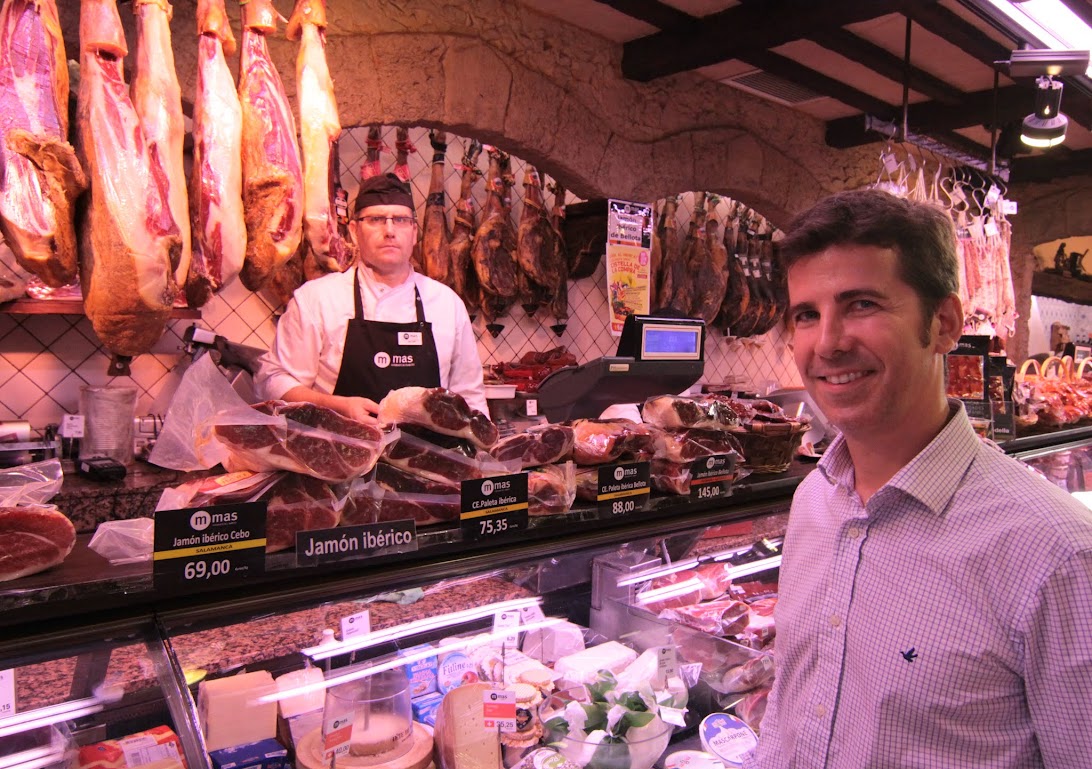
Jordi Mas's (co-author of Boquería Gourmand) family establishment, Mas Gourmets de L'Embotit (five stalls in La Boquería), specializes in Spanish hams and a variety of traditional and innovative embotits (cured meats and sausages).  Hanging from hooks attached to metal rods suspended from the ceiling are a dozen types of jamónes Ibéricos de bellota--exquisite pink-to-wine red, streaked with ethereal white-yellow fat hams from free-range pata negra (black hoof breed) pigs fattened on acorns-specially selected from three separate denominaciones de origen in western Spain.  

 
 Jordi Mas at on of his five Mas Embotits stands at la Boqueria market in Barcelona.
 Photo by Gerry Dawes©2014 / gerrydawes@aol.com / Facebook / Twitter / Pinterest.


 And, in La Boquería, a variety of butcher shops offer everything from steaks and pork chops to whole lamb, suckling pig, goat, rabbit and game birds.  Some specialize in offal--brains, livers, hearts, mounds of snow white tripe and "off" parts, pigs' trotters, lambs' heads, etc.

Another stall offers a wide range of imported and local cows', ewes' and goats' milk cheeses from Catalan Garrotxa to Extremaduran torta del Casar to French Vacherin Mont d'Or. A number of bakeries sell a wide variety of breads, pastries and pa coca, the original Catalana version of pizza.  A favorite photo opportunity is Ous de Calaf, which specializes in an impressive array of eggs from hens (organically raised), bantams, turkeys, ducks, pheasants, partridge, quail, ostrich and even emu!!  


 And, at Avinova Ous i Caça (Eggs and Game), my friend Salvador Capdevila, depending upon the season, will have rows of rabbits, partridge, ducks, geese and other game, including venison, hanging in his cases to be hand dressed or cut according to the needs of his customers, which include some of the top restaurants in Catalunya.


 Salvador Capdevila, owner of Avinova, and Catalan food writer and personality Xavi Agulló at Bar Pinotxo, Barcelona.  
Photo by Gerry Dawes©2010 / gerrydawes@aol.com.
 
Another major attraction is the seafood purveyors selling a stunning selection of fresh fish (all arranged on beds of ice) from both the Mediterranean and the Atlantic, interspersed with  a wide variety of shellfish--pink gambas (shrimp) from Denia and Pálamos on the Mediterranean, carbineros (bright scarlet prawns) from Huelva, red or blue-green llagostas (lobsters), walnut-colored, razor-case shaped navalles (razor clams) and white-pink cigalas (Dublin Bay prawns) from Galicia (many so fresh they are still alive!). These colorful market stalls bustle with constant movement with fishmongers.  


Gemma Bosch Roca at her great seafood stand in La Boquería. 
 Photo by Gerry Dawes©2014 / gerrydawes@aol.com / Facebook / Twitter / Pinterest. Panasonic Lumix DMC ZS30 43-86mm f3.3 – f6.4.


For years I have always stopped to photograph my friend, the lovely Gemma Bosch Roca, always stylishly dressed, like many women in La Boquería, wearing an elegantly embroidered bodice and looking gorgeous, all the while bagging mariscos (exquisite crustaceans and mollusks), cutting up fish, wrapping slices and filets, passing them to customers and taking payment.  Many of the women of La Boquería go to work dressed like they are going after work to attend a performance at the nearby Gran Teatre de Liceu (on Les Rambles), Barcelona's equivalent of Milano's La Scala.  (Years ago, one such well-dressed woman in a Boquería butcher's shop--before the health authorities made everyone wear gloves--spread open the carcass of a goat hanging in her stall for me to photograph with her carefully manicured, bright carmine-lacquered fingernails and the gold ring with diamonds she was wearing juxtaposed against the pink flesh of the freshly butchered animal.) 

At the back of the market, I always return to the famous stall of Bolets Petras, which even though my friend owner Llorenç Petràs has retired and left the business in the capable hands of his son, Xavier, still sells a multitude of mushrooms in season, along with truffles like the ones in the box that Isidre Gironés of Ca L'Isidre held for me to photograph twenty years ago.  


 The legendary mushroom-and-truffle guru, Llorenç Petràs, now-retired, but who just happened to be at his Petras stand in Barcelona’s Mercat de La Boquería that day (the stand is now run by his son) and showed the chefs a pile of prime black truffles.
Photo by Gerry Dawes©2014 / gerrydawes@aol.com / Facebook / Twitter / Pinterest. Canon EOS 6D / Tokina 17-35mm f/4.
 
I always finish my tour of la Boquería at Quím de la Boquería, another legendary market bar, whose slogan is "El Arte de Comer en Un Taburete" (The Art of Eating on a Barstool). I
f he is not crazy busy, I get a thumbs-up and a big abrazo from Quím Marquéz, the owner. From a small stove in impossibly tight quarters his sauteé pans flame and his plancha grill sizzles as Quím and his crew prepare some of the best food in food-crazy Barcelona.  For my "second breakfast"-- the first was at Pinotxo-knowing that I am going to be fed like a king I put myself in Quím's hands, like he did with me when I took him and his two young sons to New York City's Chinatown a few years ago.  

 
 Quím Marquéz, legendary market bar, whose slogan is "El Arte de Comer en Un Taburete" (The Art of Eating on a Barstool). 
Photo by Gerry Dawes©2014 / gerrydawes@aol.com / Facebook / Twitter / Pinterest. Canon EOS 6D / Tokina 17-35mm f/4.

Quím may make me a bowl of steaming beberechos (cockles); a plate of grilled asparagus or deep-fried artichoke hearts; an exquisite dish of shrimp with the heads still on; my beloved mongetes with butifarra and aioli; then a perfectly cooked slab of foie gras with crispy fried leeks, all accompanied by glasses of cava rosat (rosé), Catalan Champagne. 

At Quím de la Boquería, I usually meet my old friend, Salvador Capdevila, owner of Avinova and now President of La Boquería owner's association.  Sometimes Salvador, then Vice President, would come with the amiable and highly regarded Manel Ripoll, who was President of La Boquería and who also became a friend.  (Sadly, Manel and two other friends of mine, the three-star Catalan chef Santi Santamaría and Pinotxo's Albert Asín, all died early in 2011).  And during the course of the hour I may spend at Quím de la Boquería, I sometimes see some of the most famous names in Catalan gastronomy such as Juli Soler (Ferran Adrià's partner at elBulli); Ferran's brother, Albert, chef-owner of Tickets; and Christian Escribà, Barcelona's supremely talented pastry maestro and event planner. 


My late great friend Juli Soler and I in front of a photo of Christian Escribà at Escribà on Les Rambles, next to La Boquería Market, Barcelona, Jan. 11, 2014. 
Photo by a friend of Juli Soler, Hubert Wiese Tornoe, Montblanc Iberia, SLU.

But, regardless of who shows up, when I return to this gastronomic paradise that is La Boquería, I always feel like I have come home to the pueblo of my dreams.
_______________________________________________________________________________

About Gerry Dawes   

Gerry Dawes was awarded Spain's prestigious Premio Nacional de Gastronomía (National Gastronomy Award) in 2003. He writes and speaks frequently on Spanish wine and gastronomy and leads gastronomy, wine and cultural tours to Spain. He was a finalist for the 2001 James Beard Foundation's Journalism Award for Best Magazine Writing on Wine, won The Cava Institute's First Prize for Journalism for his article on cava in 2004, was awarded the CineGourLand “Cinéfilos y Gourmets” (Cinephiles & Gourmets) prize in 2009 in Getxo (Vizcaya) and received the 2009 Association of Food Journalists Second Prize for Best Food Feature in a Magazine for his Food Arts article, a retrospective piece about Catalan star chef, Ferran Adrià. 


Trailer for a proposed reality television series  
on wine, gastronomy, culture and travel in Spain.

English Version of Boquería Gourmand, a Book about Barcelona's Fabulous La Boquería Market (Foreword by Gerry Dawes)


* * * * *

Boquería Gourmand
English edition, published in October 2011 by Viena Edicions (www.vienaeditorial.com)

Email me at gerrydawes@aol.com for information about obtaining a copy of the book.


La Boquería:  My Favorite Pueblo is a Gastronomer’s Paradise
(Foreword includes additional paragraphs not in the published version.)

By Gerry Dawes©2011

Premio Nacional de Gastronomía 2003
(Stay tuned for many more photographs of La Boquería.)

El Mercat de San Josep, La Boquería. 
Photo: Gerry Dawes©2011 / gerrydawes@aol.com.
“I felt dizzy with the idea that I was part of that paradise of food. It was, and still is, a petit poble (small village) inside the big city.” - - Quím Marquéz, Chef-owner, Quím de la Boquería, Parada 606 (location), El Mercat de La Boquería. 

Quím Marquéz, Chef-owner, Quím de la Boquería
Photo: Gerry Dawes©2011 / gerrydawes@aol.com.

For forty years I have been traveling in the patrias chicas of the Iberian Peninsula.  I lived for eight years in Andalucía and have repeatedly crisscrossed El País Vasco, Galicia, Valencia, Navarra, Aragón, La Rioja, Asturias, Extremadura, the lands of Castilla y León, and all of the other provinces of Iberia, including Catalunya.  Over these decades of travel, I have come to love many "pueblos" across the vast, wonderful and exotic Iberian landscape-Sanlúcar de Barrameda (where my soul resides) and Ronda in Andalucía: Chinchón just outside Madrid; Covarrubias (Burgos); Burguete (Navarra); Haro (La Rioja), Cangas de Onís (Asturias), Gratallops (Tarragona) and Cadaqués (Girona), among many. 
 
Gerry Dawes, Juanito Bayen and Juli Soler at Pinotxo Bar, Barcelona, Jan. 14, 2014. 
 Photo courtesy of Gerry Dawes©2014 / gerrydawes@aol.com
 / Facebook / Twitter / Pinterest. Panasonic Lumix DMC ZS30 43-86mm f3.3 – f6.4.
 
As much as I long to return to such places for a variety of reasons, not the least of which is a multitude of friends and memories, few have quite the compelling attraction of Barcelona's El Mercat de San Josep, La Boquería market, which as Quím Marquéz put it so well, "still is a petit poble (small village) inside the big city" and is literally one of my favorite pueblos in the world.

Ever since I spent six weeks in Barcelona in 1970--first working as an extra on the American movie, The Great White Hope (many of the boxing scenes were filmed on Montjuic) and having anecdotal quality adventures off the set with the actor, James Earl Jones--this exciting city has occupied a favored spot in my heart.  While working on the movie, I stayed in a steeply discounted small room in the Hotel Ritz, then I moved to a very modest pensión, ironically on the calle de la Boquería.  Each day, I lived the rich Bohemian life of the legendary pedestrian artery,  Les Rambles, and the narrow, labyrinthine streets of the Barri Gotic, Raval and Born, incessantly taking photographs, including a memorable Sunday when I captured soulful images of Catalan sardana dancing in front of the Cathedral.  


Caren (from Argentina), Winged Victory. Les Rambles, Barcelona.
Photo by Gerry Dawes©2008 / gerrydawes@aol.com.

In those early days, I was not yet the gourmet and gourmand that I would become as a writer-photographer specializing in the gastronomy of Spain--in 1997, Food Arts magazine (http://www.foodarts.com/Foodarts/FA_Feature/0,4041,387,00.html) published my article on  Ferran Adrià, the first major article in the U.S. on elBulli's superstar chef.   I wandered into La Boquería on occasion (and returned there periodically on subsequent trips), but then usually I went on to explore Barcelona's other attractions- Les Rambles, the Barri Gotic, Montjuic, La Barceloneta and Antoni Gaudi's architecture.  


Lovers in Antoni Gaudí's Parque Güell, Barcelona. 
Photograph by Gerry Dawes©2010 / gerrydawes@aol.com.

It was not until 1992 that I was properly introduced to La Boquería on a pre-Olympic, gastronomic scouting trip with two major American journalists, Bryan Miller of The New York Times and William Rice of The Chicago Tribune.  With us was Spanish expatriate restaurateur, Gabino Sotelino from Chicago, who seemed to know everyone.  On our first day in Barcelona, we had an incredible breakfast in La Boquería at Bar Pinotxo, where Juanito Bayen held court and posed for his famous trademark two-thumbs-up photographs.  Catalan culinary luminaries, American chef Jonathan Waxman and writer Colman Andrews (author of Catalan Cuisine), all stopped by to say "bon día" to Juanito and see what he and his battery of cooks were serving that morning.

Juanito Bayen, owner of Pinotxo in La Boquería, Barcelona. 
Photograph by Gerry Dawes©2008. Contact: gerrydawes@aol.com

There were egg dishes, mongetes (little white beans) and butifarra blanca (Catalan sausages), grilled asparagus and more, all washed down with lots of glasses of cava (Catulunya's fine sparkling wine), then carajillos, brandy-spiked espresso with the naughty name.   Later, we went with Isidre Gironés, owner of the legendary Ca L'Isidre restaurant, to Petras's mushroom stall, where I photographed Isidre with a large box of truffles.

 
Breakfast of Champions, Mongetes con chipironcets, beans with tiny squid, with beer or cava (Catalan Champagne), Pinotxo Bar, La Boquería, Barcelona, Jan. 11, 2014. Photo by Gerry Dawes©2014 / gerrydawes@aol.com / Facebook / Twitter / Pinterest. Canon 5D Mark III / Tokina 17-35mm f/4.

After Pinotxo and my "first breakfast"-- now served to me by my friend, Jordi Asín (l).  Sadly his co-chef and a great friend of mine, brother Albert (r) died in February 2011.


Everywhere in La Boquería there is color. Artistically arranged in tiers are red, green, yellow and orange peppers; yellow-and-blush pink peaches, red, yellow and green apples, oranges, lemons and limes; shiny black or purple eggplant; green zucchini squash, green and white asparagus, artichokes and chirmoyas (custard apples); little baskets of red raspberries and currants; red and red-green tomatoes; white and red radishes, hanging strings of garlic and dried dark red ñora peppers.  Around a corner, a stand sells a dozen varieties of cured green, black and purple olives, pickled cucumbers, pickled onions, garbanzos, etc.  And another specializes in a Catalan staple, bacalao, salt cod in small stacks or in trays soaking in water, being de-salinated before cooking.

 
Eduard Soley, Vice President of La Boquería Owners Association bags a purchase at his stand in la Boquería. 
Photo by Gerry Dawes©2010 / gerrydawes@aol.com.

Jordi Mas's (co-author of Boquería Gourmand) family establishment, Mas Gourmets de L'Embotit (five stalls in La Boquería), specializes in Spanish hams and a variety of traditional and innovative embotits (cured meats and sausages).  Hanging from hooks attached to metal rods suspended from the ceiling are a dozen types of jamónes Ibéricos de bellota--exquisite pink-to-wine red, streaked with ethereal white-yellow fat hams from free-range pata negra (black hoof breed) pigs fattened on acorns-specially selected from three separate denominaciones de origen in western Spain.  

 
 Jordi Mas at on of his five Mas Embotits stands at la Boqueria market in Barcelona.
 Photo by Gerry Dawes©2014 / gerrydawes@aol.com / Facebook / Twitter / Pinterest.


 And, in La Boquería, a variety of butcher shops offer everything from steaks and pork chops to whole lamb, suckling pig, goat, rabbit and game birds.  Some specialize in offal--brains, livers, hearts, mounds of snow white tripe and "off" parts, pigs' trotters, lambs' heads, etc.

Another stall offers a wide range of imported and local cows', ewes' and goats' milk cheeses from Catalan Garrotxa to Extremaduran torta del Casar to French Vacherin Mont d'Or. A number of bakeries sell a wide variety of breads, pastries and pa coca, the original Catalana version of pizza.  A favorite photo opportunity is Ous de Calaf, which specializes in an impressive array of eggs from hens (organically raised), bantams, turkeys, ducks, pheasants, partridge, quail, ostrich and even emu!!  


 And, at Avinova Ous i Caça (Eggs and Game), my friend Salvador Capdevila, depending upon the season, will have rows of rabbits, partridge, ducks, geese and other game, including venison, hanging in his cases to be hand dressed or cut according to the needs of his customers, which include some of the top restaurants in Catalunya.


 Salvador Capdevila, owner of Avinova, and Catalan food writer and personality Xavi Agulló at Bar Pinotxo, Barcelona.  
Photo by Gerry Dawes©2010 / gerrydawes@aol.com.
 
Another major attraction is the seafood purveyors selling a stunning selection of fresh fish (all arranged on beds of ice) from both the Mediterranean and the Atlantic, interspersed with  a wide variety of shellfish--pink gambas (shrimp) from Denia and Pálamos on the Mediterranean, carbineros (bright scarlet prawns) from Huelva, red or blue-green llagostas (lobsters), walnut-colored, razor-case shaped navalles (razor clams) and white-pink cigalas (Dublin Bay prawns) from Galicia (many so fresh they are still alive!). These colorful market stalls bustle with constant movement with fishmongers.  


Gemma Bosch Roca at her great seafood stand in La Boquería. 
 Photo by Gerry Dawes©2014 / gerrydawes@aol.com / Facebook / Twitter / Pinterest. Panasonic Lumix DMC ZS30 43-86mm f3.3 – f6.4.


For years I have always stopped to photograph my friend, the lovely Gemma Bosch Roca, always stylishly dressed, like many women in La Boquería, wearing an elegantly embroidered bodice and looking gorgeous, all the while bagging mariscos (exquisite crustaceans and mollusks), cutting up fish, wrapping slices and filets, passing them to customers and taking payment.  Many of the women of La Boquería go to work dressed like they are going after work to attend a performance at the nearby Gran Teatre de Liceu (on Les Rambles), Barcelona's equivalent of Milano's La Scala.  (Years ago, one such well-dressed woman in a Boquería butcher's shop--before the health authorities made everyone wear gloves--spread open the carcass of a goat hanging in her stall for me to photograph with her carefully manicured, bright carmine-lacquered fingernails and the gold ring with diamonds she was wearing juxtaposed against the pink flesh of the freshly butchered animal.) 

At the back of the market, I always return to the famous stall of Bolets Petras, which even though my friend owner Llorenç Petràs has retired and left the business in the capable hands of his son, Xavier, still sells a multitude of mushrooms in season, along with truffles like the ones in the box that Isidre Gironés of Ca L'Isidre held for me to photograph twenty years ago.  


 The legendary mushroom-and-truffle guru, Llorenç Petràs, now-retired, but who just happened to be at his Petras stand in Barcelona’s Mercat de La Boquería that day (the stand is now run by his son) and showed the chefs a pile of prime black truffles.
Photo by Gerry Dawes©2014 / gerrydawes@aol.com / Facebook / Twitter / Pinterest. Canon EOS 6D / Tokina 17-35mm f/4.
 
I always finish my tour of la Boquería at Quím de la Boquería, another legendary market bar, whose slogan is "El Arte de Comer en Un Taburete" (The Art of Eating on a Barstool). I
f he is not crazy busy, I get a thumbs-up and a big abrazo from Quím Marquéz, the owner. From a small stove in impossibly tight quarters his sauteé pans flame and his plancha grill sizzles as Quím and his crew prepare some of the best food in food-crazy Barcelona.  For my "second breakfast"-- the first was at Pinotxo-knowing that I am going to be fed like a king I put myself in Quím's hands, like he did with me when I took him and his two young sons to New York City's Chinatown a few years ago.  

 
 Quím Marquéz, legendary market bar, whose slogan is "El Arte de Comer en Un Taburete" (The Art of Eating on a Barstool). 
Photo by Gerry Dawes©2014 / gerrydawes@aol.com / Facebook / Twitter / Pinterest. Canon EOS 6D / Tokina 17-35mm f/4.

Quím may make me a bowl of steaming beberechos (cockles); a plate of grilled asparagus or deep-fried artichoke hearts; an exquisite dish of shrimp with the heads still on; my beloved mongetes with butifarra and aioli; then a perfectly cooked slab of foie gras with crispy fried leeks, all accompanied by glasses of cava rosat (rosé), Catalan Champagne. 

At Quím de la Boquería, I usually meet my old friend, Salvador Capdevila, owner of Avinova and now President of La Boquería owner's association.  Sometimes Salvador, then Vice President, would come with the amiable and highly regarded Manel Ripoll, who was President of La Boquería and who also became a friend.  (Sadly, Manel and two other friends of mine, the three-star Catalan chef Santi Santamaría and Pinotxo's Albert Asín, all died early in 2011).  And during the course of the hour I may spend at Quím de la Boquería, I sometimes see some of the most famous names in Catalan gastronomy such as Juli Soler (Ferran Adrià's partner at elBulli); Ferran's brother, Albert, chef-owner of Tickets; and Christian Escribà, Barcelona's supremely talented pastry maestro and event planner. 


My late great friend Juli Soler and I in front of a photo of Christian Escribà at Escribà on Les Rambles, next to La Boquería Market, Barcelona, Jan. 11, 2014. 
Photo by a friend of Juli Soler, Hubert Wiese Tornoe, Montblanc Iberia, SLU.

But, regardless of who shows up, when I return to this gastronomic paradise that is La Boquería, I always feel like I have come home to the pueblo of my dreams.
_______________________________________________________________________________

About Gerry Dawes   

Gerry Dawes was awarded Spain's prestigious Premio Nacional de Gastronomía (National Gastronomy Award) in 2003. He writes and speaks frequently on Spanish wine and gastronomy and leads gastronomy, wine and cultural tours to Spain. He was a finalist for the 2001 James Beard Foundation's Journalism Award for Best Magazine Writing on Wine, won The Cava Institute's First Prize for Journalism for his article on cava in 2004, was awarded the CineGourLand “Cinéfilos y Gourmets” (Cinephiles & Gourmets) prize in 2009 in Getxo (Vizcaya) and received the 2009 Association of Food Journalists Second Prize for Best Food Feature in a Magazine for his Food Arts article, a retrospective piece about Catalan star chef, Ferran Adrià. 


Trailer for a proposed reality television series  
on wine, gastronomy, culture and travel in Spain.

Wednesday, August 24, 2016

Looking Back on the Galician Forest Fires of 2006 and Ribadavia in the Ribeiro Wine District


* * * * *
  
Ribavia's old Jewish quarter.

All around the old Galician Ribeiro town of Ribavia, which has a charming old Jewish quarter, are picturesque wine-growing hamlets surrounded by rustic, trellised, small plot vineyards planted long ago on granite-butressed terraces. These vineyards are of another age and are among of the most picturesque in Spain. 


On this trip, when I was looking for the vineyards of Emilio Rojo in the hamlet of Arnoia, it was disconcerting to happen upon yet another suspicious Galician forest fire raging southeast of town and potentially threatening a particularly beautiful spread of old vineyards and the houses built among them. The scene became totally surreal when helicopters and fire planes began to fly overhead, racing back and forth over the vineyards to the Minho river and a nearby reservoir to collect water for bombing runs on the raging fire.


Ribavia is dotted with charming, old wine-growing villages hemmed by rustic, trellised small plot vineyards planted long ago on granite-buttressed terraces. These viñedos are of another age and are among of the most picturesque in Spain. While looking for the vineyards of Emilio Rojo in the hamlet of Arnoia, it was disconcerting to happen upon a forest fire, thought to be set by an arsonist, raging southeast of town and potentially threatening a particularly beautiful spread of old vines and the quaint stone houses that stood among them. 

The scene became totally surreal when helicopters and fire-fighting planes swooped in, flying back and forth to the Minho river and a nearby reservoir to collect water for "bombing runs." Unfortunately, this was not be the last time I came upon such a scene during this August trip. (If one tastes a smoky quality in some 2006 Galician whites, in all seriousness, it will not be from a toasted barrel.)

 The Genesis of The Spanish Artisan Wine & Spirits Group - Gerry Dawes Selections


____________________________________________________________________________________

About Gerry Dawes


Writing, Photography, & Specialized Tours of Spain & Tour Advice
For custom-designed tours of Spain, organized and lead by Gerry Dawes, and custom-planned Spanish wine, food, cultural and photographic itineraries, send inquiries to gerrydawes@aol.com.  


I have planned and led tours for such culinary stars as Chefs Thomas Keller, Mark Miller, Mark Kiffin, Michael Lomonaco and Michael Chiarello and such personalities as baseball great Keith Hernandez and led on shorter excursions and have given detailed travel advice to many other well-known chefs and personalities such as Drew Nieporent, Norman Van Aken, Karen Page and Andrew Dornenberg, Christopher Gross, Rick Moonen, James Campbell Caruso and many others.

 * * * * * 
“The American writer and town crier for all good Spanish things Gerry Dawes . . . the American connoisseur of all things Spanish . . .” Michael Paterniti, The Telling Room: A Tale of Love, Betrayal, Revenge and The World’s Greatest Piece of Cheese

* * * * *

"Gerry Dawes, I can't thank you enough for opening up Spain to me." -- Michael Chiarello on Twitter. 

"Chiarello embarked on a crash course by traveling to Spain for 10 days in 2011 with Food Arts
contributing authority Gerry Dawes, a noted expert on Spanish food and wine.  Coqueta's (Chiarello's new restaurant at Pier Five, San Francisco) chef de cuisine, Ryan McIlwraith, later joined Dawes for his own two week excursion, as well. Sampling both old and new, they visited wineries and marketplaces, as well as some of Spain's most revered dining establishments, including the Michelin three-star Arzak, Etxebarri, the temple to live fire-grilling; Tickets, the playful Barcelona tapas bar run by Ferran Adrià and his brother, Albert; and ABaC, where Catalan cooking goes avant-garde." - - Carolyn Jung, Food Arts, May 2013.


* * * * *

"In his nearly thirty years of wandering the back roads of Spain," Gerry Dawes has built up a much stronger bank of experiences than I had to rely on when I started writing Iberia...His adventures far exceeded mine in both width and depth..." -- James A. Michener, author of Iberia: Spanish Travels and Reflections
 * * * * *
Gerry Dawes was awarded Spain's prestigious Premio Nacional de Gastronomía (National Gastronomy Award) in 2003. He writes and speaks frequently on Spanish wine and gastronomy and leads gastronomy, wine and cultural tours to Spain. He was a finalist for the 2001 James Beard Foundation's Journalism Award for Best Magazine Writing on Wine, won The Cava Institute's First Prize for Journalism for his article on cava in 2004, was awarded the CineGourLand “Cinéfilos y Gourmets” (Cinephiles & Gourmets) prize in 2009 in Getxo (Vizcaya) and received the 2009 Association of Food Journalists Second Prize for Best Food Feature in a Magazine for his Food Arts article, a retrospective piece about Catalan star chef, Ferran Adrià.

". . .That we were the first to introduce American readers to Ferran Adrià in 1997 and have ever since continued to bring you a blow-by-blow narrative of Spain's riveting ferment is chiefly due to our Spanish correspondent, Gerry "Mr. Spain" Dawes, the messianic wine and food journalist raised in Southern Illinois and possessor of a self-accumulated doctorate in the Spanish table. Gerry once again brings us up to the very minute. . ." - - Michael & Ariane Batterberry, Editor-in-Chief/Publisher and Founding Editor/Publisher, Food Arts, October 2009. 

 Pilot for a reality television series with Gerry Dawes  
on wine, gastronomy, culture and travel in Spain.

Experience Spain With Gerry Dawes: Customized Culinary, Wine & Cultural Trips to Spain & Travel Consulting on Spain

Gerry Dawes can be reached at gerrydawes@aol.com

Thursday, April 28, 2016

Blind Tasting: Fool’s Teflon by W.R. Tish

Blind Tasting: Fool’s Teflon

Posted on  | April 6, 2012   Bookmark and Share
Written by |

As wine judgement goes, this technique is overrated and unrealistic.
Read the other day that a wine critic was going to taste at Screaming Eagle and Harlan Estate in Napa, but that he would be scoring either “since they chose not to let me blind taste.” Huh? I was not sure whether to laugh or cry.Since when is not knowing what’s in the glass a prerequisite for officially assessing quality? For now, let’s focus just on the notion that putting on a wine-tasting blindfold is the equivalent of, if not Superman’s cape, at least a shield of Teflon.

In my experience, blind tasting is inescapably circumstantial. Its value should be couched in the context in which the wine was sampled, especially when presented in a “flight.” I was reminded of this recently when Casa Lapostolle staged a blind tasting of “luxury” Cabernets. My favorite (and the media group’s) was the Lapostolle 2008 Cuvée Alexandre (SRP $25).

But I am hesitant to believe that one such tasting is definitive. It is what it was. Indeed it raised my assessment of Casa Lapostolle, but I am not going to write it off as vintage-schizophrenic, nor am I dumping Chateau Montelena (one of my lesser favorites) off my list of Napa classics. Most of all, it served to reinforce the fact that any wine is so much more than its impression in one glass on one day in one situation. Wine is a package deal: its origin, production details, price and, yes, its packaging all matter.

Tool for Discovery

My take is that blind tasting is most valuable when it is conducted extremely casually—as in a mystery bottle amid a sampling of known wines, yielding a fun “aha!” moment, shared by a group of people—or when it is conducted extremely rigorously. I witnessed the effectiveness of the latter context recently as a spectator during the Ultimate Spirits Challenge (see page 58). Quite simply, the combination of expert judges, airtight secrecy and a multi-panel, multiround format that ensures checks-andbalances yields results that stand reliably above single-critic reviews.

The basic flaw inherent in most wine critics’ blind tastings is the fact that people + wine is a recipe for imprecision, no matter how experienced the taster. Even Robert Parker, who at least has the courage to occasionally taste blind in public, has demonstrated that he cannot reproduce his impressions with statistical reliability. Plus, wine itself does not stand pat; it changes, both in the bottle over the long term and in the glass for the short term. And, oh, there’s that little thing called food, which is ultimately part of almost every wine’s final destination (at the table).

Sure, there is a place in the world for blind tasting. It is a tool for discovery. But making it a requirement for judgment is unrealistic, and deeming its results sacrosanct is just foolish. So why does the wine industry vest so much clout in blind-rated reviews conducted by middle-aged men sampling 20+ wines at a pop without a crumb to eat? The only logical answer is that the “blindness” built into their evaluation process theoretically yields objectivity, whereas knowing what’s in the glass unleashes bias.

Me? I’ll trust the judgment of an eyes-open taster any day of the week.

It takes relatively little effort to plow through a blind flight of wine. It takes a lot more conviction to be a real-world judge—selecting wines, labels and all—and then standing behind them to re-sell at specific prices. Retailers and restaurant wine pros make the tough decisions, paring down a universe of options to a finite set of wines, and for that they deserve more credit than any wine critic hiding behind the Teflon of a tasting blindfold.

Sunday, February 14, 2016

Bierzo: A Region's Rapid Climb From Obscurity to Recognition / Viña Barroca Bierzo Mencía 2009, Bodegas Adrià (Vilafranca del Bierzo, Léon)

* * * * *
Click on the title to read:
Wines From Spain News, Winter 2007


(Slide Show: Double click on the image to go to Picasa to see an enlarged version, 
then click on F11 for a full screen version; click ESC to leave slide show.)


Viña Barroca Bierzo Mencía 2009 (far right) from Bodegas Adrià (Vilafranca del Bierzo, Léon) which also makes Vega Montán. 
All photographs by Gerry Dawes©2011. Contact: gerrydawes@aol.com

Along this wine did not exist when this article was written, the vines did and budding star winemaker, Diego Losada, has created something special in this young Mencía red wine, so we  are proud to offer in October our Bierzo selection, Viña Barroca 2009 from Bodegas Adria.

Bodegas Adrià has had as their consultant one of the top young winemakers in the region, Diego Losada, who apprenticed under such winemaking stars as Gregory Pérez of Bodegas y Viñedos Mengoba, Alejandro Luna at Bodegas y Viñedos Luna Beberide and maestro Mariano and son Eduardo García in their Paixar project. 


Damián Canepa, Export Manager of Bodegas Adria, Bierzo. Canepa worked at Bodegas Peique in Bierzo for six years, helping to build that winery's name. 
All photographs by Gerry Dawes©2011. Contact: gerrydawes@aol.com

Tasting note:


Viña Barroca Bierzo Mencía 2014 (13.5%) $14.99 SRP.
100% Mencía  Diego Losada, winemaker

Deep pomegranate juice colored red.  POM fruit with whiffs of minerals.  

Utterly delicious, juicy, lovely sweet red fruit (currants, pomegranate) with a touch of volatility that makes it so good with food.  Solid mineral underpining in the finish with iron-like notes from the arcilloso soil on which the grapes are grown.

- - Gerry Dawes

Saturday, August 29, 2015

Ajo blanco (gazpacho blanco or gazpacho a la Malagueña [Malaga-style gazpacho])


* * * * *


Ajo blanco (gazpacho blanco or gazpacho a la Malagueña [Malaga-style gazpacho]), made with almonds, bread, garlic, Sherry vinegar, salt and water, usually garnished with green grapes, sometimes with diced apples, as shown here. Ajo blanco looks like a bowl of the whitewash that is used to keep houses white in many parts of Spain, but this dish is one of the greatest folk dishes of Spain. The juxtaposition of the texture of the ground almonds and bread, garlic, vinegar and salt with the tart sweetness of the grape or apple garnishes makes for a compelling dish, whose flavors are addictive. Photo by Gerry Dawes©2015 / gerrydawes@aol.com / Facebook / Twitter / YouTube / Pinterest. Samsung Galaxy S5 Phone Camera 16MB.